Positive Medical Progress
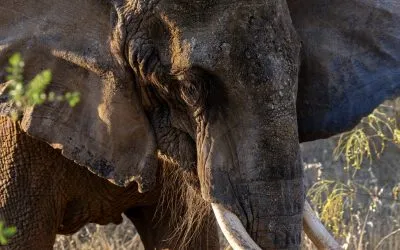
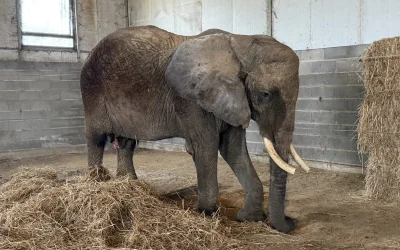
Since our last update, Kariba has continued to recover from the infections that delayed her move to Pangea earlier this year. We are relieved to share her ear is healing well, and the other infections have almost completely healed. Based on her progress, the veterinary team at Pakawi Park considers Kariba nearly fit to travel from a medical perspective.
This is encouraging news after several difficult months. Getting Kariba comfortable with the transport crate is another important part of preparing for her move that has proven more challenging than anticipated. We want to be open about these difficulties, the risks involved in moving Kariba, and why we are taking care not to rush the next steps.
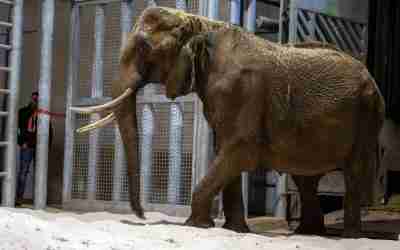
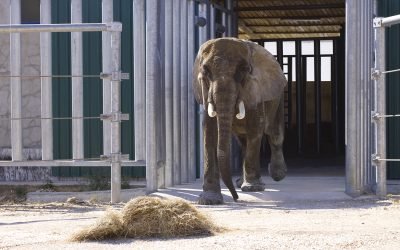
Building Kariba’s confidence with her training crate has proven more difficult than anticipated. Here we can see how she enters to receive her reward, but then quickly backs out of the crate, showing she does not yet feel comfortable staying inside it for extended periods of time.
The Challenges of Crate Training
Moving an elephant is an incredibly complex process that can require months of preparation depending on the individual. Kariba will need to undertake a two-day journey from Belgium to Portugal, and it’s important that she feels as relaxed and secure inside it as possible, both for her own safety and that of the transport team. She also needs to be comfortable entering and leaving the crate during loading and unloading. Any hesitation or distress could make the process more difficult and increase the risks to her welfare.
The training is based on positive reinforcement. Rather than forcing Kariba into the crate, her caregivers use food rewards, repetition and encouragement to help her become familiar with it at her own pace. The process begins with allowing her to approach and explore the crate, before gradually encouraging her to walk through it and eventually stand inside for longer periods. The aim is for her to enter willingly and remain as relaxed as possible, rather than simply getting her inside and hoping she will tolerate the journey.
Unfortunately, this process has been particularly difficult with Kariba. Despite ongoing efforts, she has remained very reluctant to become comfortable with the crate. This has made it difficult to progress with the training to the point where we would feel confident about moving her.
Adapting to the Individual
It is important to understand that every elephant is different. Some become comfortable with a transport crate within a matter of weeks, while others may need six months or longer. There is no fixed timeline, and an elephant’s previous experiences, health and confidence can all affect how quickly she progresses.
For Kariba, the past six months have been especially difficult. Her initial foot abscess was followed by further infections, including a serious ear infection that resulted in the loss of part of that ear. These medical complications have required repeated veterinary interventions and changes to her normal routine. Understandably, this has taken a toll on her. The treatments and disruptions to daily life appear to have left her more anxious and less comfortable with unfamiliar experiences. This has made it harder for her caregivers to build the confidence she needs to enter the crate willingly.
We recognise how frustrating these delays may be for everyone who has been following Kariba’s journey, particularly after we had hoped she would already be at Pangea by now. Her medical recovery is encouraging, but the physical and psychological aspects of moving an elephant who has recently experienced a lot of stress also needs to be considered before we can feel confident that the rewards outweigh the risks.
We expect to make a decision regarding Kariba’s rehoming in the coming weeks. Please stay tuned, and as always, thank you for your support and believing in what we are building.